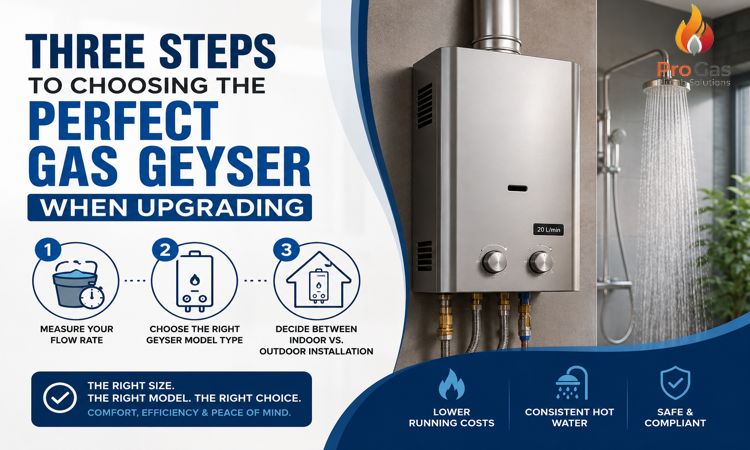
Three Steps to Choosing...
 25 May 2026


 11 May 2026
 Posted By admin

The South African national standards were updated in August 2024, according to which all new gas installations in South Africa must comply with SANS 10087-1:2024 (Edition 7). Fail to adhere to these standards, and your gas installation will not receive a Gas CoC (Certificate of Conformity).
This doesn’t just become a roadblock when it comes to insurance documentation, but it renders your home insurance completely void. Plus, no property can be sold/transferred without a valid Gas CoC. The lack of a valid Gas CoC creates a legal liability, making the property owner financially and legally responsible for any damage.
While the installer is responsible for issuing the CoC, homeowners also play a significant part in having the necessary paperwork for a smooth Gas CoC process. This guide will walk you through the exact requirements.
In South Africa, the Gas CoC is not mere paperwork or a simple approval process. It is a legal document that states that your LPG installation adheres to the regulatory standards set by the government.
Ii is a part of the legal obligation under the Occupational Health and Safety Act No. 85 of 1993 and the Pressure Equipment Regulations, according to which every fixed gas installation must have a Certificate of Conformity (CoC).
The absence of a Gas CoC also poses Insurance risk since insurers can reject claims if there is no valid CoC. In addition, the CoC must not be older than 3 months at time of property transfer.
These make it a necessity to have a valid CoC at all times.
To successfully obtain a Gas CoC, the five documents are a must:
Always get your work done by an installer who is registered with SAQCC Gas. This is the body mandated by the Department of Employment and Labour to certify gas practitioners and registering is compulsory under the OHS Act.
The installer’s digital licence card (now issued via the Electronic CoC App) confirms their registration category (domestic, commercial, or industrial). Further, installers can only work in categories they hold the license for.
If an unregistered person does the work, no valid CoC can be issued and you carry full legal liability.
Every appliance connected to your gas installation must have the relevant SANS standard and carry an SABS-approved mark. This holds true for your stove, geyser, fireplace, braai, and anything else tht you wish to connect.
If you are planning to connect a fancy imported appliance, please note that they must have an SABS approval mark, without which they cannot be legally certified. Your installer will check for the SABS-approved mark during the inspection.
Thus, always purchase appliances from reputable suppliers and retain the purchase documentation.
During installation, the installer must have a plan that shows cylinder placement, pipe routing, appliance positions, and the location of the emergency shut-off valve. Per the SANS 10087-1:2024, cylinders must have a minimum distance of
Although you do not need an architectural blueprint, a clear dimensioned drawing is a must.
The CoC is always issued against your property. Thus, the installer or issuing body will seek confirmation of the installation address and the homeowner’s relationship to it.
If you are applying as a tenant a signed landlord letter or lease agreement confirming consent to the installation is required.
In case you are planning to sell your property, the CoC must be no older than 3 months on date of transfer.
Under the updated SANS 10087-1:2024 standard, the certificate of conformity is now issued digitally via the SAQCC Gas Electronic CoC App. This happens once the installer completes the application after inspecting and pressure-testing the installation.
This digital CoC serves as the confirmation of compliance with SANS-10087-1-2024 Edition 7.
| Document Required | Issued By / Source | When Needed | |
| 1 | Installer’s SAQCC Gas Registration Card | SAQCC Gas (Department of Labour) | Before work begins |
| 2 | Proof of Appliance Compliance (SABS mark) | Appliance manufacturer / retailer | Before installation |
| 3 | Site/Layout Plan of Installation | Homeowner / installer | Before inspection |
| 4 | Property Ownership Proof (Title Deed or lease) | Deeds Office / landlord | Before certificate issue |
| 5 | Completed SAQCC Digital CoC Application | Registered installer via CoC App | After installation & testing |
Unless your documentation is in order and your installation strictly adheres to the updated SANS 10087-1:2024 standards.
As a result, the installation cannot legally be used and the property transfer is blocked until a valid CoC is obtained. Your insurance claims related to gas damage will be denied. Further, the liability in case of accidents becomes the owner’s sole responsibility.
A certified gas installer handles the full documentation process for CoC, starting from verifying appliance compliance to submitting the digital CoC application.
If you’re planning a new gas installation or need an updated certificate before a property sale, contact experts for a no-obligation quote.
Under SANS 10087-1:2024, any modification to a gas installation, including adding or replacing an appliance, requires a new inspection and a fresh CoC. Also, the installer must test the full system, not just the new appliance.