How to Find the...
 20 May 2026


 25 May 2026
 Posted By admin
The cost of operating an electric water heater accounts for a significant portion of the electricity bill for households across South Africa. The increase in Eskom tariffs which rose 12.74% in 2024-25 and a further 12.7% in 2025-26 also contributed to this.
The result is that a number of households are upgrading to gas geysers which can operate independently of the grid. However, gas geysers are sized differently from electric ones. Getting the sizing wrong means cold showers in winter, fluctuating water temperatures, or a geyser working beyond its design capacity.
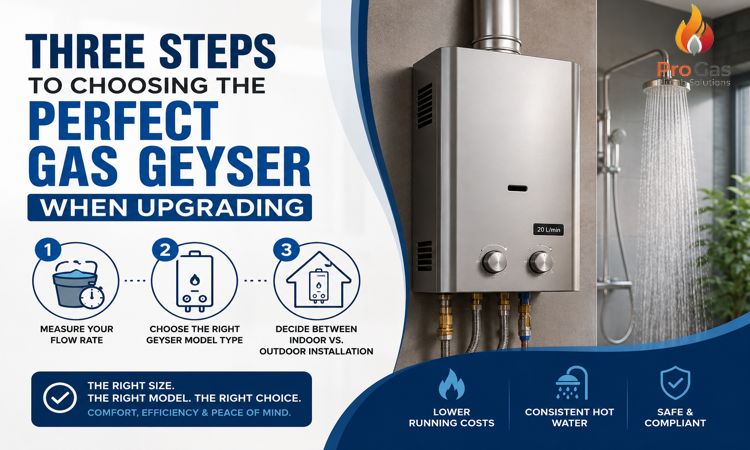
Here, we are going to outline three steps that simplify the process for you.
Electric geysers heat stored water using a heating element. Unlike these, gas geysers are instantaneous, i.e., they heat water as it flow through. As a result, they are sized in litres per minute (L/min) which accounts for the volume of water the unit can heat to a set temperature rise every minute.
A standard gas geyser heats incoming water by approximately 25°C above ambient temperature at its rated flow rate. In winters, incoming mains water can be 10-12°C. This means a correctly sized unit must still deliver a comfortable 35-40°C at the shower head under those conditions.
An undersized geyser doesn’t just deliver lukewarm water. It can create pressure and temperature instability across water outlets.
When choosing a gas geyser South Africa, these are the steps you need to follow:
Your geyser must be sized to match your home’s water flow rate, not the water pressure. This is the volume of water that passes through your tap per minute, and is determined by both pressure and pipe diameter.
Perform the Bucket Test by placing a bucket of known volume under each hot water outlet, turning on the tap fully, and calculating how long it takes for the bucket to fill completely. If you have multiple outlets, run all of them at the same time and add the individual flow rates.
| Household Scenario | Simultaneous Outlets | Typical Flow Demand | Minimum Geyser Size |
| Single person / 1 bathroom | 1 shower | 6-8 L/min | 16 L/min (minimum recommended) |
| Couple / 1 bathroom and kitchen | 1 shower and 1 sink | 10-12 L/min | 16 L/min |
| Family of 4 / 2 bathrooms | 2 showers simultaneously | 12-14 L/min | 16-20 L/min |
| Large household / 3+ bathrooms | 2-3 showers + kitchen | 16-20 L/min | 20 L/min or 2 units |
Table 1: Minimum geyser size as per household.
Always step up your geyser size when buying since cold water during winter can reduce the effective output of the geyser.
Once you know the flow rate, the next step is to choose the geyser model type. In the South African market, the four main types available are:
| Model Type | How It Works | Best For | Key Consideration |
| Diaphragm-activated | Water pressure activates the gas burner via a diaphragm | Budget-conscious single-outlet homes | Most affordable; temperature varies with flow changes |
| Constant temperature | Thermostat auto-adjusts flame to maintain set temperature | Multi-outlet homes; families; medium-large homes | More stable temperature across outlets; mid-range cost |
| Fan-forced (room-sealed) | Powerful fan circulates combustion air; indoor sealed installation with flue | Larger households; installation where outdoor placement is not possible | Most efficient; requires flue to outside |
| Low-pressure eco-flow | Designed for low or gravity-fed water pressure systems | Off-grid, rural, tank-fed supply | Not suitable for standard municipal pressure |
Table 2: Gas geyser models available.
The placement of your geyser has a direct impact on which model is suitable, what compliance requirements apply, and what the installation will cost.
| Factor | Indoor Installation | Outdoor Installation |
| Flue requirement | Mandatory; must vent combustion gases to outside | Not required for open-combustion outdoor-rated units |
| Weather protection | Not applicable | Weather box or enclosure needed to preserve warranty and lifespan |
| Model compatibility | Room-sealed fan-forced units or Type A/B units with flue | Standard outdoor-rated units; diaphragm or constant temperature |
| SANS 10087-1:2024 rule | Bathroom installations must be flued to outside and have permanent ventilation | Cylinder must be 1m from doors/windows; 2m from drains |
| Carbon monoxide risk | Higher; flue integrity must be verified by installer | Lower; combustion gases disperse naturally outdoors |
Table 3: Factors that influence indoor vs. outdoor installation.
Before choosing a gas geyser South Africa, speak to your installer and get a confirmation regarding the following:
Choosing the right gas geyser is simpler when you have an SAQCC-registered installer working with you since the beginning. Start with doing the bucket test, choose the right geyser size based on your household requirements, and hire a certified installer for the installation and CoC.
Not completely. An electric geyser is usually placed in a fixed indoor location (like ceiling void or utility cupboard). A gas geyser replacing it in the same space will need a flue to be routed to the outside wall (for CO exhaust). The gas supply pipe (in copper) will have to be run to that location. Plus, the existing electrical geyser wiring will have to be decommissioned.