Three Steps to Choosing...
 25 May 2026


 20 May 2026
 Posted By admin
In South Africa, Eskom direct-customer tariffs rose 12.74% in April 2024 and this one of the major reasons why households are shifting to using LPG for cooking. In fact, the national LPG consumption hit 500,000 metric tons in 2024, up from 425,000 in 2023.
Most buyers either want the best appliance in the market or one that fits tidily into their budget. However, neither is the right way to buy your gas stove. Instead, it is important to take a look at your kitchen layout, household size, or cooking habits. Failing to account for these is no doubt going to result in costly reworks and/or CoC delays.
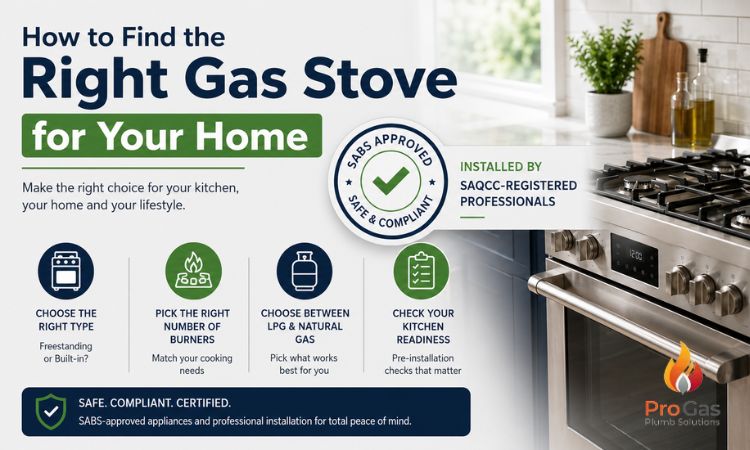
This guide walks through the four decisions that matter most, so you choose once and choose right.
Under SANS 10087-1:2024 (Edition 7), any fixed gas stove installation requires the following:
It is important to keep in mind that the type of stove you choose directly affects installation complexity, countertop modification requirements, and therefore cost and timeline. This makes it important to plan your appliance and installation work together.
When choosing your gas stove, these are the four decisions that matter most:
This is ‘the choice’ that affects everything from your kitchen layout to your installation needs. At a glance, here’s how they compare to each other.
| Freestanding Gas Stove | Built-In Gas Hob | |
| What it is | All-in-one unit with hob and oven. Slides into a gap between cabinets. | Hob only design that cuts into the countertop. Oven sold/installed separately. |
| Best for | Rental properties, budget-conscious buyers, traditional kitchens, families needing an oven. | Modern fitted kitchens, homeowners who already have an electric oven, premium kitchen aesthetics. |
| Installation | Simple design that connects to gas supply at the back. No countertop cutting needed. | Requires precise countertop cut to fit appliance dimensions; concealed piping run. |
| Kitchen flexibility | Can be repositioned easily. | Permanent installation where the countertop modification cannot be reversed easily. |
| Cylinder compatibility | LPG (standard) or natural gas with conversion jets on most models. | LPG (standard) or natural gas with conversion jets on most models. |
Table 1: Comparison between freestanding gas stoves and built-in hobs.
Regardless of the type, the stove you choose must carry an SABS mark confirming that it meets South African standards. Imported appliances without an SABS approval cannot be legally certified, as a result of which the CoC cannot be issued.
Not every household needs a huge four-burner gas oven. Let’s take a look at which fits a household best, based on the household profile:
| Household Profile | Recommended Burners | Typical Stove Type |
| 1-2 person flat or apartment | 2 burners | Table-top/countertop 2-burner or compact freestanding |
| 2-4 person family, single chef | 4 burners | Standard freestanding stove or 60 cm built-in hob |
| 4-6 person family, frequent entertaining | 4-5 burners (including wok burner) | 90 cm freestanding or built-in hob with wok burner |
| Large household or keen cook | 5-6 burners | 90 cm dual-fuel range or professional-style freestanding |
Table 2: Burner recommendations based on household profile.
Most South African residential installations use LPG (Liquefied Petroleum Gas), especially common in Centurion and greater Gauteng. Natural gas via a piped grid is only available in select urban areas in South Africa, particularly Egoli Gas in Johannesburg and Sasol pipeline zones in Gauteng/KZN.
Many appliances are designed to work with both, supporting a jet conversion kit. However, this conversion must be done by a registered installer, not the homeowner. Further, a fresh CoC is needed on completing this conversion.
Before ordering your appliance, a site assessment must be done to check for the following:
Before buying your stove, it is important to check for the following:
Choosing the right gas stove starts with a thorough site assessment, and this can only be conducted by an SAQCC-certified installer. Opt for a certified installer who can assess your kitchen layout, advice on appliance compatibility, handle the full installation, and issue your digital CoC, ensuring your appliance is usable from day one.
A maximum of one 9 kg cylinder can be stored indoors. The cupboard must have permanent floor-level ventilation (not a sealed base), and the orange hose connecting the cylinder to the appliance must not pass through any solid partition. The cylinder valve area must remain accessible at all times.