Three Steps to Choosing...
 25 May 2026


 17 May 2026
 Posted By admin
As a result of load shedding and rising electricity tariffs, the number of people who owned gas appliances increased from 19% in 2022 to over 30% in 2023. In fact, 36.3% of Gaunteng households used LPG in 2023. Even if the statistic seems old, the trend is not.
LPG consumption in 2024 was estimated to be 500,000 metric tons (up from 425,000). With this surge in the number of people buying gas appliances has led to the increase of poorly planned gas installations.
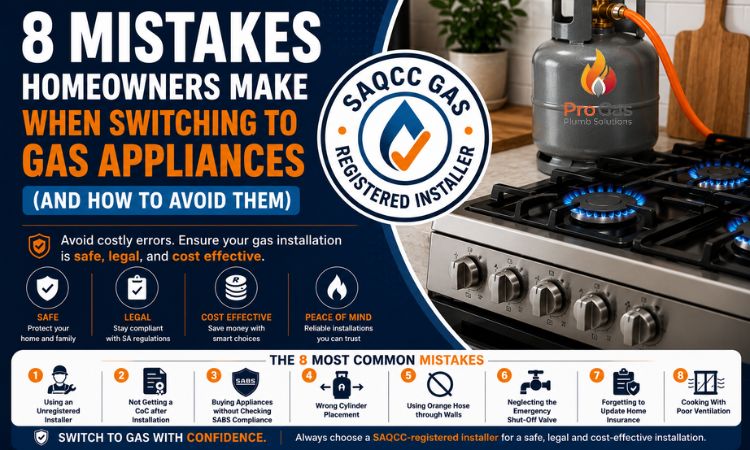
We are going to cover the eight most common mistakes and what you should do instead so that your switch to gas is safe, legal, and cost effective.
From simple to complex, let’s take a look at the eight mistakes made by South Africans when switching to gas:
Your installer is that person who visits your home and connects your new gas cylinders to your appliances with proper routing through valves and piping. In this regard, South African law is unambiguous. The installer must be registered with SAQCC Gas (authorised under the OHS Act No. 85 of 1993) to be able to legally install gas appliances.
A poorly installed gas system can cause gas leaks, fires, explosions, and even carbon monoxide poisoning. This makes it important to verify the installer’s registration at www.saqccgas.co.za before any work begins.
While issuing the CoC is the installer’s job, holding a valid CoC is the owner’s responsibility. Without a valid CoC, the homeowner is held legally and financially liable for any accidents caused due to the installation. Without it, insurance claims can be denied and property transfers blocked.
Always insist on a digital CoC via the SAQCC Gas app before considering the job complete. Also, keep in mind that under SANS 10087-1:2024, existing installations must also be re-inspected every 5 years.
You might wish to install imported appliances, but gas appliances without an SABS approval mark cannot be legally certified. Thus, you will not be issued a CoC for a non-compliant appliance.
Thus, it is always best to purchase from reputable retailers, check the SABS mark, and retain the purchase invoice.
For the safety of your household installation, the SANS 10087-1:2024 specifies exact placement distances for gas cylinders. These violations are also one of the most common reasons why gas inspections fail.
| Restriction | Minimum Distance Required |
| From doors and windows (sideways) | 1 metre |
| From drains and air vents | 2 metres |
| From electrical switches / pool pumps | 5 metres |
| From boundary walls (unless double-brick firewall) | 1 metre |
Table 1: Minimum distances to be maintained for gas installations.
Also keep in mind that that maximum cylinder size that you can store indoors is 9kg.
LPG installations often use orange hoses to connect the appliances to the cylinders. However, most people aren’t aware that these reinforced orange LPG hoses must not:
If the piping for your gas installation runs through walls, copper piping must be used. This is a specification that registered installers are aware of.
According to the SANS Codes, an accessible emergency shut-off valve must be placed as close as possible to where the main gas pipe enters the building. Often people are unaware, which is why residential buildings often have this valve is installed outside.
This significantly increases response time when there is an emergency. This makes it important to discuss valve placement with your installer before works begin.
Once you have built the new gas installation and obtained a CoC, your home insurance policy must be updated to explicitly cover compliant gas installations. Insurers can reject claims if they find the installation was not certified.
After any new gas installation, appliance addition, or other work done, notify your insurer, provide a copy of the CoC, and update your insurance (if needed).
Gas stoves release nitrogen dioxide (NO2), carbon monoxide, and other by-products of combustion. In poorly ventilated spaces (particularly relevant in SA kitchens where windows and doors may be kept closed during load shedding), this can pose a significant risk to health.
Thus, it is important to always cook with windows open. You can also install a carbon monoxide detector near your cooking area.
Avoiding these 8 mistakes starts with choosing the right installer. To switch to gas with confidence, always choose n SAQCC-registered installer who can handle appliance compliance checks, correct cylinder placement, CoC documentation, and post-installation briefings.
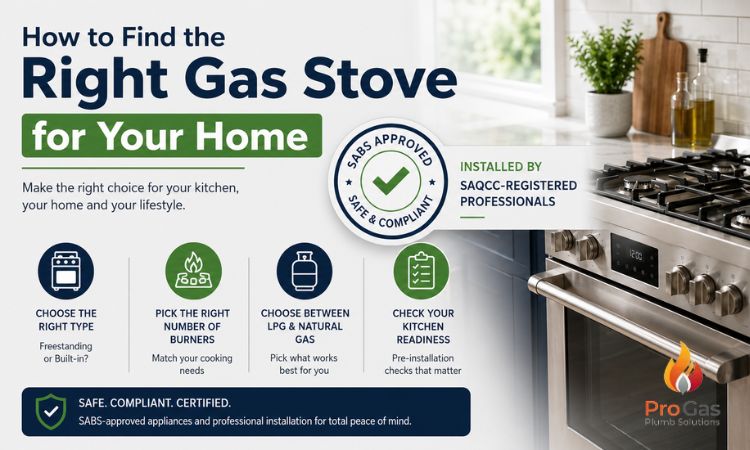
A gas stove is a purpose-built appliance. You cannot convert an electric stove to gas. You need to purchase a gas stove or hob designed for LPG use, verified with an SABS mark, and have it installed by a registered gas practitioner.